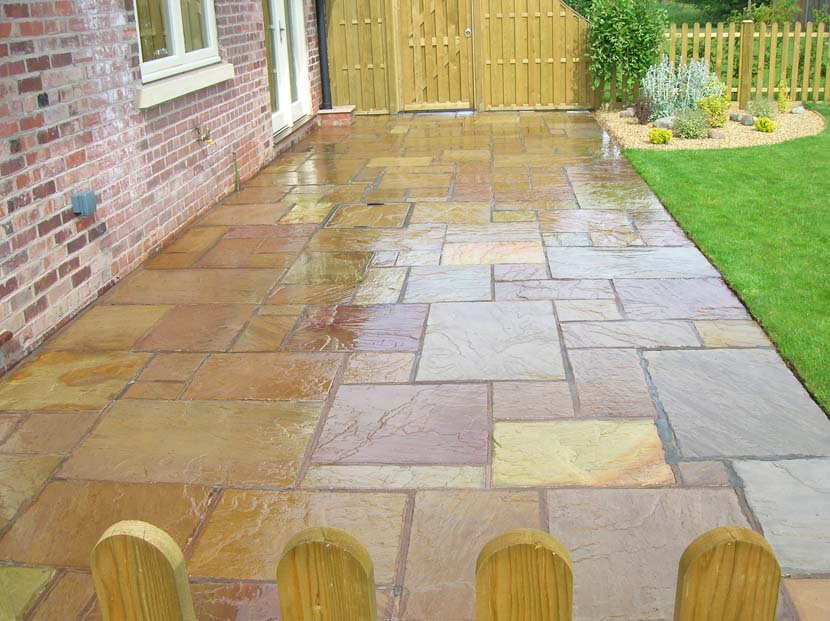
Correctly installed, an Indian sandstone drive is a long-lasting surface that can withstand almost heavy traffic. With good drainage and regular cleaning, the paving stone can withstand winter’s ice and snow easily. Giving the flagstone paving a detailed cleaning before winter is the most significant part of preseason care.
However nicely a pavement might be set, and however much was spent on the quality materials, all Indian paving, from the top of the range to the not-quite-so-great, need some basic care to keep them looking their finest. Those fast talking sales people that promise a “care-free” paving do not know the half of it. Cleaning and maintenance keep paving in prime condition and not caring for your Indian paving will cause it to deteriorate.
Even if it’s only a basic wash down with soapy water, all kinds and kinds of paving be much better with a simple washing, while specific kinds of paving often want a little more care and consideration to ensure they consistently look their best. The great news is that cleaning is generally simple, and even the most neglected or battered Indian pavement can frequently be given a fresh lease of life with only a little effort. Below is how to clean Indian sandstone courtesy of Indian Sandstone specialists Stone Traders:
1. Initial cleaning of the pavement
Remove everything that may be sitting on top of the pavement. This comprises plants, chairs, tables, etc. Also, sweep off the surface of the platform, to remove loose debris like dirt, leaves, and twigs. After this first sweeping, hose down the veranda, to do an initial cleaning. The sandstone must be fully dried before continuing or you may damage the sandstone.
2. Scrub off the soil
A sandstone paver gathers soil because of the rough texture of the sandstone. When you walk on the veranda, you can leave a trail of mud as you walk on the sandstone. The mud will entrench itself to the pavement, and a basic hose down will not be enough to remove it. Mix warm water with some drops of detergent, and then lightly scrub the platform. Let the soap sit on the pavement for a few minutes before hosing down the pavement.
3. Remove spots and stains
There’s not only one method to remove spots found on sandstone. For organic spots like mildew and mold, use hydrogen peroxide to take it off. For oil, apply acetone. Taking off grease stains is a different deal though, you have to place mound talc on the spot. Each of these systems with the exclusion of talc, are scrubbed on. After several minutes you’ll be able to hose down the sandstone paver patio.
4. Fill the gaps with sand
When a pavement is being constructed out of sandstone, sand is used as a stand-in for concrete or grout. The gap in-between each Indian sandstone should be filled up annually. Pour sand and brush it on the paver inside the joints. Fill them up as much as you can and apply more sand. Once the sand dries it will become hard as concrete.
5. Seal the Sandstone
Sealing the Indian sandstone is really critical to keeping it longer lasting. Select a sealer that’s safe for sandstone, and then apply it to the veranda using a regular paintbrush. When you apply the sealer, make sure you do so with an extremely thin layer. Additionally, it should be applied with soft and slow strokes, so you don’t leave behind stripes. Let the sealer dry for a whole day, and after that, apply another layer.
Maintenance Tips
Materials like mildew, algae, and moss makes drives slick and causes irreversible damage to Indian stone paving. A mild mixture of bleach can be used to take them off. Stains from oil and grease are a more demanding issue. If a mixture of water and dish soap does not fix the problem, you can attempt a diluted solution of mineral spirits, ammonia or acetone.
An Indian sandstone pavement patio is stylistically pleasing and is easy to install. The sandstone paver can add value to the house, but one drawback is leaving it unmaintained and uncleaned. If an Indian sandstone pavement isn’t correctly maintained, the color can fade off, and the sandstone itself can crumble and break.
